


What is Chemisorption?
Chemisorption is a chemical adsorption process, caused by a reaction on an exposed surface, which creates an electronic bond between the surface and the adsorbate. During the chemical reaction, a distinct chemical species is created on the adsorbent surface, which causes the bond to be created.
Chemisorption is used in development, monitoring and measuring of corrosion inhibitors and is used for measuring surface active sites on a substrate.
During the chemisorption process the adsorbing gas or vapor molecule splits into atoms, radicals, ions that form a chemical bond with the adsorption site. This interaction involves the sharing of electrons between the gas and the solid surface and may be regarded as the formation of a surface compound.
Chemisorption Instruments
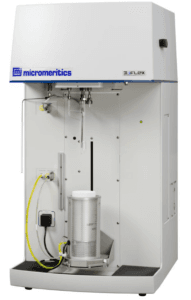
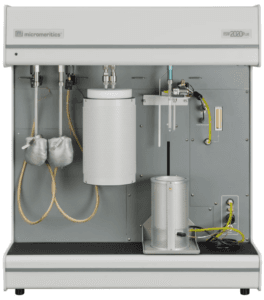
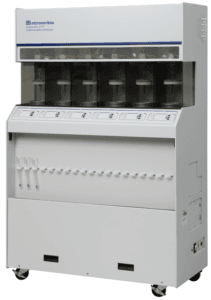
We offer two instrumental techniques for chemisorption analysis, the static volumetric technique and the dynamic (flowing gas) technique. The static chemisorption technique is performed by both the Micromeritics 3Flex, and the ASAP 2020 Plus, which operates over a range of pressures.
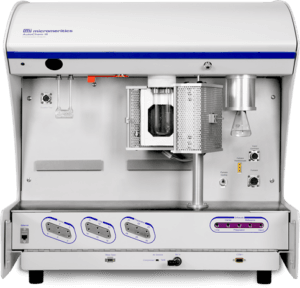
The dynamic chemisorption technique is utilized by the 3Flex, ChemiSorb, and AutoChem series of instruments. These three instruments utilize pulse chemisorption in a dynamic flow system to titrate the active surface.
Static Chemisorption
In static adsorption, generally two adsorption ‘isotherms’ (quantity of gas adsorbed as a function of pressure at constant temperature) are collected at sub-atmospheric pressures: the first representing total adsorption, the second representing reversible adsorption, and the difference between the two representing the irreversible adsorption (i.e. ‘chemisorption’).
This technique provides information on the quantity of adsorption sites, from which subsequent calculations may be done. When the active surface area analysis is performed at one specific temperature, it is called isothermal chemisorption.
Dynamic Chemisorption
In dynamic chemisorption, the identity, quantity, and strength of active sites can be quantified by adsorption, desorption, or reaction under isothermal or temperature programmed conditions. Dynamic chemisorption utilizes a variety of techniques such as temperature programmed reduction (TPR), oxidation (TPO), desorption (PTD), and pulse chemisorption to characterize active sites in materials.
For the dynamic system, depending on the experiment, a lower concentration of active gas may be in contact with the sample for only a few seconds. Depending on the sample, equilibration and access of the active gas to the adsorption sites of interest may be faster in the static system.